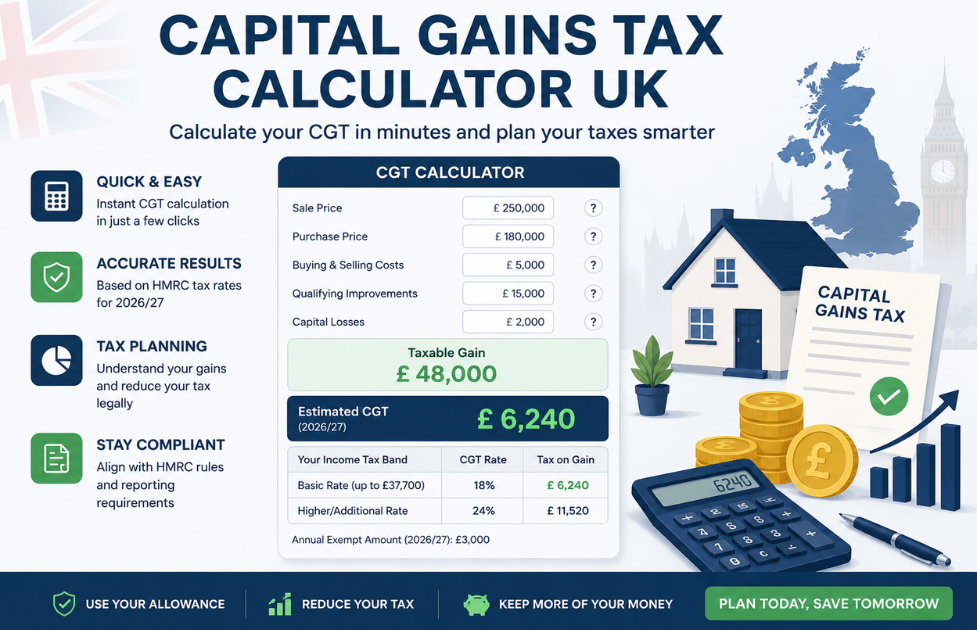
Selling an investment, second home, shares, or other valuable assets at a profit may trigger Capital Gains Tax (CGT) in the UK. Understanding how your tax liability is calculated is essential for effective financial planning and avoiding unexpected tax bills.
A capital gains tax calculator UK helps estimate the amount of CGT you may owe by considering your taxable gain, annual income, available allowances, and the applicable HMRC tax rates.
While a calculator provides a useful estimate, understanding the rules behind the calculation is equally important. This guide explains how Capital Gains Tax works in the UK for the 2026/27 tax year, how to calculate taxable gains, current HMRC tax rates, annual allowances, property-specific rules, available reliefs, reporting requirements, and practical tax-planning strategies.
| Capital Gains Tax Feature | Key Information (2026/27 UK Tax Year) | Why It Matters |
| Annual Exempt Amount | £3,000 tax-free allowance for individuals | Only gains above this amount are generally subject to Capital Gains Tax. |
| Basic Rate CGT | 18% on most chargeable gains | Applies to gains that fall within the basic income tax band. |
| Higher & Additional Rate CGT | 24% on most chargeable gains | Applies to gains above the basic rate threshold. |
| Assets Commonly Taxed | Investment property, shares, investment funds, ETFs, certain bonds, and cryptocurrency | Knowing which assets are chargeable helps you accurately estimate your tax liability. |
| Allowable Deductions | Purchase costs, solicitor fees, estate agent fees, qualifying improvement costs, and allowable capital losses | These deductions reduce your taxable gain and may lower your CGT bill. |
| Common Reliefs | Private Residence Relief, Business Asset Disposal Relief (where eligible), Capital Loss Relief, and spouse or civil partner transfers | Reliefs can significantly reduce or eliminate the amount of Capital Gains Tax payable. |
| Reporting Methods | HMRC Self Assessment tax return or HMRC online Capital Gains Tax reporting service (where eligible) | Ensures you report and pay Capital Gains Tax correctly and on time. |
| Smart Tax Planning Tips | Use your annual allowance, offset capital losses, invest through ISAs, consider pension contributions, and plan disposals carefully. | Effective planning can help reduce your overall Capital Gains Tax liability while remaining compliant with HMRC rules. |
What Is Capital Gains Tax?

Capital Gains Tax is a tax charged on the profit (gain) you make when selling or disposing of certain assets that have increased in value. Importantly, CGT is calculated only on the gain, not on the total selling price.
Assets commonly subject to Capital Gains Tax include:
- Buy-to-let and second homes
- Shares and investment portfolios
- Business assets
- Investment funds
- Certain valuable personal possessions
- Cryptocurrency (subject to HMRC rules)
Some assets, including your main residence under qualifying circumstances, may be fully or partly exempt.
How a Capital Gains Tax Calculator UK Works

A calculator estimates your potential tax liability by using several financial details.
Typically, you will need:
- The purchase price of the asset
- The selling price
- Allowable buying and selling costs
- Improvement costs (where eligible)
- Capital losses
- Your total taxable income
- Annual CGT allowance
After entering this information, the calculator estimates your taxable gain and applies the appropriate HMRC Capital Gains Tax rate based on your income tax band.
Remember that online calculators provide estimates and cannot replace professional tax advice for complex situations.
How to Calculate Capital Gains Tax
The basic calculation follows a simple process.
Step 1: Calculate Your Gain
Subtract the original purchase price from the selling price.
Capital Gain = Selling Price − Purchase Price
Step 2: Deduct Allowable Costs
Certain expenses can reduce your taxable gain, including:
- Solicitor fees
- Estate agent commissions
- Stamp Duty Land Tax paid when purchasing (where applicable)
- Survey fees directly related to acquisition
- Costs of qualifying property improvements
Routine repairs and maintenance costs generally cannot be deducted.
Step 3: Deduct Capital Losses
If you sold another asset at a loss during the same tax year, or have eligible carried-forward losses, these may reduce your taxable gain.
Step 4: Apply the Annual Exempt Amount
For the 2026/27 tax year, individuals generally have an Annual Exempt Amount of £ 3,000.
Only gains above this allowance are subject to Capital Gains Tax.
HMRC Capital Gains Tax Rates (2026/27)
The rate you pay depends on your taxable income and the type of asset you are selling.
| Category | 2026/27 Rate |
| Annual Exempt Amount | £3,000 |
| Basic Rate Taxpayers (Most Chargeable Gains) | 18% |
| Higher & Additional Rate Taxpayers (Most Chargeable Gains) | 24% |
Your income tax band determines whether all or part of your gain is taxed at the lower or higher rate.
Capital Gains Tax on Property Sales
Property transactions often generate larger gains than other investments, making accurate calculations especially important.
Capital Gains Tax may apply when selling:
- Buy-to-let properties
- Holiday homes
- Second homes
- Inherited property (in some situations)
- Investment property
In many cases, your main residence qualifies for Private Residence Relief, meaning some or all of the gain may be exempt.
If the property is jointly owned, each owner calculates tax only on their share of the gain.
Market Value Rules
Instead of the sale price, market value may need to be used if:
- The property was gifted (subject to specific exceptions)
- It was sold below market value
- The inheritance valuation is unavailable
- The property was owned before April 1982
Capital Gains Tax on Shares and Investments

Capital Gains Tax is not limited to property sales. You may also be required to pay CGT when disposing of other chargeable assets, including listed shares, investment funds, exchange-traded funds (ETFs), certain bonds, and cryptocurrency investments.
When calculating your taxable gain, only assets that have been sold, transferred, or otherwise disposed of during the relevant tax year are taken into account.
Allowable Costs That Reduce Your Tax Bill
Many taxpayers overlook deductions that legally reduce Capital Gains Tax.
Allowable costs often include:
- Purchase-related legal fees
- Selling costs
- Estate agent commissions
- Professional valuation fees
- Structural improvements and extensions
- Certain acquisition costs
Keeping detailed records and receipts is essential if HMRC requests evidence.
Capital Gains Tax Reliefs
Several reliefs may reduce or eliminate your tax liability.
Common reliefs include:
Private Residence Relief
If the property has been your main home throughout your ownership, you may pay little or no Capital Gains Tax.
Business Asset Relief
Certain qualifying business disposals may receive favourable tax treatment.
Capital Loss Relief
Losses from other investments may offset taxable gains during the current or future tax years.
Transfers Between Spouses
Assets transferred between spouses or civil partners are generally not subject to Capital Gains Tax immediately, allowing couples to make better use of available allowances.
Smart Ways to Reduce Your Capital Gains Tax
Proper tax planning can significantly reduce future liabilities.
Consider these strategies:
- Use your annual exempt amount every tax year.
- Invest through a Stocks and Shares ISA where gains are generally free from CGT.
- Contribute to a pension, if eligible, to potentially reduce your taxable income.
- Offset gains using allowable capital losses.
- Spread disposals across multiple tax years where practical.
- Consider transferring qualifying assets to a spouse or civil partner before disposal.
Professional advice is particularly valuable for high-value investments and property portfolios.
Reporting and Paying Capital Gains Tax
If your taxable capital gains exceed the applicable thresholds, you may be required to report them to HMRC. Depending on the type of asset you have disposed of, this can usually be done through a Self Assessment tax return or, if eligible, via HMRC’s online Capital Gains Tax reporting service.
It’s important to note that the reporting deadlines for residential property sales may differ from those for other investments, so you should always check the latest HMRC guidance to ensure your return is submitted on time.
Common Mistakes to Avoid
Many taxpayers accidentally increase their tax liability through avoidable errors.
Common mistakes include:
- Forgetting to deduct allowable costs
- Ignoring capital losses
- Missing reporting deadlines
- Failing to keep supporting documents
- Using incorrect purchase values
- Overlooking available tax reliefs
- Assuming every property sale is taxable
Good record-keeping can make calculating Capital Gains Tax much easier.
Conclusion
Using a capital gains tax calculator UK is an effective way to estimate your potential tax liability before selling property, investments, or other chargeable assets. However, obtaining an accurate result also requires understanding HMRC rules on allowable costs, annual exemptions, reliefs, reporting obligations, and current tax rates.
By maintaining detailed records, planning disposals carefully, making full use of available reliefs, and seeking professional advice for complex situations, you can manage your Capital Gains Tax efficiently while remaining fully compliant with UK tax legislation.
Want to know about Foreclosure Lawyer: A Complete Guide to Cost, Free Consultation & Legal Help Check out our Real Estates category.
Frequently Asked Questions
It estimates the amount of Capital Gains Tax you may owe based on your taxable gain, annual income, available allowances, and the applicable HMRC tax rates. It provides an estimate rather than a final tax calculation.
For the 2026/27 tax year, the Annual Exempt Amount is £3,000 for most individual taxpayers. You generally pay Capital Gains Tax only on gains above this allowance.
Most UK Capital Gains Tax calculators automatically apply the current Annual Exempt Amount when estimating your tax liability. However, you should always check that the calculator is up to date for the correct tax year.
Yes. Transfers of assets between spouses or civil partners are generally exempt from Capital Gains Tax, allowing couples to make better use of available tax allowances before selling qualifying assets.