
Choosing no win no fee solicitors should involve more than comparing headline percentages or reading reviews. You need to know whether the firm is regulated, who will handle your case, what its written terms promise, and what happens if the service falls short.
The safest approach is to verify the firm and named case handler with the SRA, then read the client-care documents before signing. Compare the service and cost, and understand the complaints and switching process in advance: a funding promise matters, but the quality and accountability of the legal service matter throughout the claim.
| Check | What to look for |
| Firm regulation | Exact legal name and SRA record |
| Person handling the claim | Name, role, professional status, and supervisor |
| Client-care documents | Scope, costs, exclusions, timescales, and responsibilities |
| Communication | Named contact and realistic update arrangements |
| Complaints | Firm procedure plus legal Ombudsman details |
| Regulatory history | Relevant SRA decisions, read in context |
| Service history | Legal Ombudsman decisions, not complaint numbers alone |
| Switching terms | Exit costs, file transfer, and any live court deadlines |
The Solicitors Regulation Authority regulates solicitors and authorised law firms in England and Wales. Its Solicitors Register is the definitive public source for checking whether a person is a solicitor and whether a firm is SRA-regulated.
That gives you a practical starting point before you sign anything.
How to Verify No Win No Fee Solicitors With the SRA
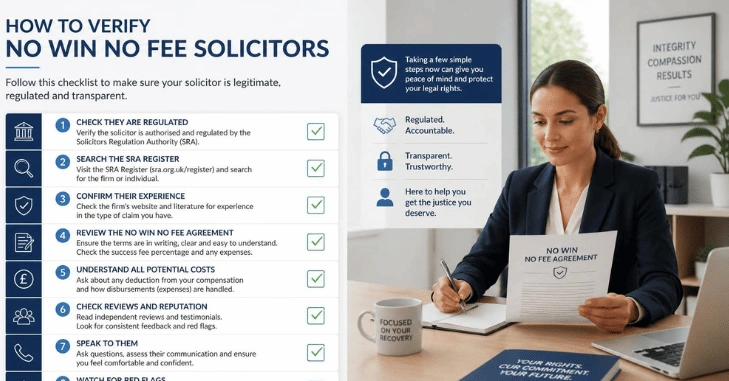
No win no fee solicitors A professional-looking website is not proof that the business behind it is a regulated law firm.
The SRA says its register can be used to check both people and firms. It also warns that if a search produces no result, you should not assume the person or business is regulated.
Use the register in two stages.
1. Check the Firm itself.
Take the legal name from the firm’s website, engagement documents, or email footer. Then search that name in the Firm section of the Solicitors Register. Check that the details correspond with the business you intend to instruct.
Do not rely only on a trading name or logo. If the paperwork names a different company or legal entity, verify that entity as well.
An SRA-regulated firm comes with regulatory protections that differ from those attached to some other legal-service arrangements. The SRA says regulated law firms are subject to minimum insurance requirements and regulatory complaint protections.
2. Check the Person Who Is Actually Handling Your Case
This is where many people stop their checks too early.
Ask the firm:
- Who will have day-to-day responsibility for my claim?
- Are they a solicitor, trainee, paralegal, or another type of case handler?
- Who supervises them?
- Who makes important strategic decisions on the claim?
- Who will speak to me when advice or settlement decisions are needed?
Only people approved by the SRA can call themselves solicitors. Other legal staff can work on matters too, so the person handling much of your file may not personally hold that title.
If someone is presented to you as a solicitor, search their name in the register and confirm where they work.
If your day-to-day handler is not a solicitor, ask for the supervising solicitor’s name and verify that person instead.
This matters because you are choosing a legal team, not a website.
For a complex clinical negligence claim, for example, Justice’s birth injury lawyer guide also stresses the importance of asking who will actually run the file. Do not assume that the senior lawyer used for marketing will handle the day-to-day work.
3. Check Published Regulatory Decisions Carefully
The SRA also provides a search facility for regulatory and disciplinary decisions.
You can search a person’s or firm’s record for outcomes such as fines, rebukes, conditions, tribunal referrals, and interventions. Yet this is not a complete lifetime scorecard. The SRA says not all decisions are published, and those that are generally remain on its website for three years.
Use a record as a prompt for further questions rather than jumping to a conclusion based on one entry.
Read the Client-Care Letter Before You Agree to Anything

Your engagement paperwork may be called a client-care letter, terms of business, retainer, funding agreement, or a combination of documents.
The label matters less than whether the information is understandable.
SRA-regulated firms have obligations to give clients information about their services when the relationship begins and as the matter develops. That includes information about likely costs and how to complain. The SRA says a client care letter is a common way for firms to provide that information.
Its guidance says good client-care information should make several points easy to identify.
What work has the firm agreed to do?
Look for a clear description of the legal work. The document should help you distinguish between what is included in the retainer and what is outside it. SRA guidance recommends clearly explaining the agreed work, next steps, and any exclusions.
For a claim, this could affect questions such as whether the firm will obtain records, instruct experts, negotiate with an insurer, issue court proceedings, or arrange counsel.
Do not assume a task is included because it seems obvious.
Who is your contact?
You should be able to identify a named contact and know how to reach the team. SRA client-care guidance specifically recommends providing contact details and explaining what the client needs to do.
Check whether the named person matches the individual discussed during the sales or intake process. If the letter names a team rather than a person, ask who owns the file on a day-to-day basis.
What should happen next, and when?
A useful engagement letter should not leave the process completely open-ended.
The SRA recommends explaining the next steps and likely timescales for the agreed work.
Exact claim durations cannot always be predicted. You can ask for a service framework.
Useful questions include the following.
- When will the firm review the evidence?
- When should you expect the first substantive update?
- What events will trigger contact?
- How quickly does the firm normally respond to client messages?
- Who covers the case handler during an absence?
Those answers reveal more about the service than a promise to “keep you updated.”
What could you have to pay?
Fee mechanics should be explained in the written agreement, but they do not need to dominate your choice of firm. Check when fees become payable, any agreed success fee, the treatment of disbursements or insurance, and what the contract says about ending or transferring the retainer. The SRA requires clear information about likely costs and potential additional costs.
Then move on to the service terms.
How do you complain?
This should be easy to find before a problem exists. SRA rules require firms to make information available about their complaints procedure and about routes to the Legal Ombudsman and SRA. Firms with websites must publish complaint information there.
Save a copy of the procedure when you instruct the firm. Policies and webpages can change later.
How to Compare Firms Sensibly

A useful comparison asks, “Which firm is most likely to handle this claim well?” rather than “Which advert sounds cheapest?”
Compare each candidate using the same criteria.
| Question | Firm A | Firm B | Firm C |
| SRA-regulated firm verified? | |||
| Named case handler? | |||
| Handler’s status explained? | |||
| Supervising solicitor identified? | |||
| Experience with this claim type? | |||
| Is the scope of work clear? | |||
| Communication standard explained? | |||
| Exit terms clear? | |||
| Is the complaints procedure easy to find? | |||
| Written answers provided before signing? |
Experience should be specific.
A firm that handles thousands of claims across several fields is not automatically a stronger choice than a smaller specialist team. Ask about experience with your type of dispute or injury.
For a property accident, Justic’s guide to premises injury claims and choosing representation covers the evidence and legal work particular to those cases.
The same principle applies elsewhere: compare relevant expertise, not total marketing volume.
Use Legal Ombudsman Data Without Treating It Like a Star Rating
The Legal Ombudsman publishes data about final Ombudsman decisions.
That can add another layer to your checks, but raw complaint counts can be misleading.
The Ombudsman itself advises consumers to consider the provider’s size, the work it does, and, most importantly, the outcomes of complaints. A large practice handling thousands of files may naturally appear more often than a small practice.
Look at:
- Whether the Ombudsman found poor service.
- Whether a remedy was required.
- What the complaint concerned.
- Whether the firm’s own complaint handling was considered reasonable.
- Whether similar issues appear repeatedly.
One complaint should not automatically eliminate a firm.
A recurring pattern of poor communication, ignored instructions, or weak complaint handling warrants closer scrutiny.
What to Do When the Service Starts Going Wrong

Do not wait until the end of the case if a manageable problem appears early.
If updates have stopped, instructions seem to be ignored, or you no longer understand what is happening, raise the problem first with the person handling the claim.
Put important concerns in writing.
State:
- What happened.
- When it happened.
- What you expected.
- What you want the firm to do.
- When you need a response, particularly if a legal deadline is approaching.
Keep copies of messages and responses.
If the issue cannot be resolved informally, use the firm’s formal complaint procedure.
The SRA says making a complaint should not affect how the firm handles the underlying case.
How to Complain to the Firm and Then the Legal Ombudsman
The Legal Ombudsman deals with complaints about legal services, including issues such as poor communication, delays, and bills. The SRA deals primarily with regulatory conduct.
For a service complaint, start with the firm. The Legal Ombudsman says the legal service provider has up to eight weeks to try to resolve the complaint. You may go to the Ombudsman after receiving a final response if you remain dissatisfied, or once eight weeks have passed without a resolution.
The Legal Ombudsman time limits
The current scheme rules require careful attention to three time limits.
A complaint normally needs to reach the Legal Ombudsman:
- Within one year of the act or omission complained about; or
- Within one year of when you should reasonably have known there was cause to complain; and
- Within six months of the firm’s final written response, where that response properly explains the Ombudsman route and the six-month limit.
Do not interpret the eight weeks as permission to ignore the wider time limits.
If a deadline is close, check the Ombudsman’s current rules promptly.
Legal Ombudsman or SRA: Which One Do You Need?
The two organizations do different jobs. Contact the Legal Ombudsman when the central problem is the service you received. Examples include delay, poor communication, failure to progress the matter, or a dispute about the bill.
Consider reporting the issue to the SRA when it raises a serious professional or regulatory concern. Its published examples include dishonesty, misuse of client money, misleading the court, serious conflicts, discrimination, and seriously reckless or incompetent behavior that puts a client or case at risk.
The SRA does not usually investigate ordinary service complaints such as isolated delays, communication problems, or fee disagreements. Nor can it generally order a firm to compensate you for poor service. Some situations can involve both routes.
Can You Change Solicitor During a Claim?
Yes, changing legal representation during a civil claim is possible. The practical question is whether switching improves your position enough to justify the disruption and possible cost.
Start by finding a replacement firm willing to take over the matter. Give the new lawyer the important documents and explain why you want to move.
Ask the prospective firm to review:
- The current stage of the claim.
- Upcoming limitation or court deadlines.
- Existing expert evidence.
- Offers already made.
- Your present retainer.
- The old firm’s accrued costs.
- The likely cost of taking over.
Do this before ending the existing relationship where possible.
A new firm may decide that it cannot take the case on the same funding terms.
That is particularly important in complex or expensive litigation.
If your documents refer to outside litigation finance as well as a solicitor’s retainer, treat that as a separate funding relationship with an outside funder, which the replacement firm also needs to review.
What happens if court proceedings have already started?
Once civil proceedings are underway, a formal procedural step follows. Civil Procedure Rule 42.2 says that when a party changes solicitor, notice of the change must be filed with the court and served on the other parties and the former solicitor.
Practice Direction 42 says Form N434 is normally used for a change outside the MyHMCTS process.
Your new firm will normally deal with the procedural requirements upon agreeing to take over.
The priority is continuity. Do not allow a transfer to cause a missed court order, hearing date, or other deadline.
What Does Switching Solicitor Cost?
There is no single fixed switching fee. The amount depends on the contract you signed, the work already completed, the stage of the claim and the terms on which the replacement firm agrees to act. Read the termination section of your original documents before giving notice.
Ask the existing firm for a written statement explaining:
- Costs incurred so far.
- Disbursements already paid.
- Any amount it says becomes payable on termination.
- How those costs are calculated.
- How the file will be transferred.
- Whether it claims any right to retain papers because of unpaid costs.
The Law Society notes that a solicitor can, in some circumstances, exercise a lien over client papers for unpaid costs. Its client information guidance recommends warning clients about that possibility at the outset of the retainer. That does not mean every file transfer will be blocked.
It means you should establish the cost and document-transfer position before announcing a switch.
If you think a solicitor’s bill is excessive, a separate court procedure also exists for challenging a bill. GOV.UK states that an application for detailed assessment normally has the strongest procedural protection when made within one month of receiving the bill, with different rules applying later.
Get individual advice before starting a costs challenge.
What Happens to Your Case File?
A case file is not necessarily one indivisible bundle owned entirely by one side. Ownership can depend on the type of document and the circumstances in which it was created. The Law Society has specific guidance distinguishing documents owned by the client from documents owned by the firm.
Your replacement lawyer should therefore arrange the transfer directly with the former firm. Ask for confirmation that essential file materials have been transferred, including relevant correspondence, medical or expert evidence, court papers, offers, schedules, and key dates. Do not assume the transfer is complete merely because you have signed with a new practice.
Should You Complain or Switch?
Not every service problem requires an immediate transfer.
A formal complaint may be the better first move when:
- The problem is recent.
- A new case handler could solve it.
- The firm acknowledges the issue.
- Important work has otherwise been done well.
- Switching would create disproportionate delay.
Moving firms becomes more attractive when confidence has broken down, and the underlying problem continues.
Examples include repeated failures to follow instructions, unexplained inactivity, persistent communication problems, or a material difference between the service provided and what the engagement documents led you to expect.
A complaint and a switch are not mutually exclusive.
You can complain about past service while arranging different representation for the future.
Seven Checks Before You Choose a Firm

Before signing, complete these checks:
- Search the exact firm name on the SRA Solicitors Register.
- Ask who will handle your file and verify anyone described as a solicitor.
- Identify the supervising solicitor to whom day-to-day work is delegated.
- Read the client-care documents for scope, service, costs, and termination terms.
- Compare experience with your exact type of claim rather than relying on broad claims volume.
- Read the firm’s complaints procedure and check relevant Ombudsman and regulatory records in context.
- Ask what happens if you later want to change representation.
For additional claim-specific comparisons, Justic’s Find a Lawyer guides cover factors to consider across different areas of legal practice.
Conclusion
No Win No Fee solicitors can make legal representation more accessible by allowing eligible clients to pursue certain claims without paying their solicitor’s usual fees upfront. However, the phrase does not always mean that every possible cost disappears. The exact arrangement, potential success fee, insurance costs, disbursements, and any expenses payable if the case is unsuccessful can depend on the agreement and the type of claim.
Before choosing a solicitor, take time to understand exactly how the fee arrangement works. Ask for the terms in writing and check what percentage may be deducted from compensation if you win, what costs are included, whether any additional expenses could arise, and what happens if the case does not succeed.
Frequently Asked Questions
Search both the firm and any individual described as a solicitor on the SRA Solicitors Register. The SRA calls the register its definitive impartial source for regulated firms and people. If no matching record appears, do not assume the provider is regulated.
Not every member of a legal team is a solicitor. Regulated firms may use paralegals, trainees, and other staff. Ask for the case handler’s status and, where relevant, the name of the solicitor supervising the matter. Only SRA-approved people can call themselves solicitors.
Check the scope of work, what is excluded, likely costs, possible extra costs, likely timescales, what you need to do, who your contact is and how complaints are handled. Those points reflect the SRA’s client-care guidance.
A legal service provider has up to eight weeks to resolve a complaint before you can normally take an unresolved matter to the Legal Ombudsman. You can also escalate sooner after receiving the firm’s final response if you remain dissatisfied.
Yes. The normal limits include one year from the relevant act or omission, or one year from when you should reasonably have known there was cause for complaint. A six-month limit following a compliant final response from the firm also applies.
Yes. Check the termination terms, accrued costs, file-transfer arrangements, and whether another firm is prepared to take over before ending the current retainer. If court proceedings have started, the change must also be formally notified under Civil Procedure Rule 42.
Changing representation does not itself determine whether the claim succeeds. The practical risks are disruption, additional cost, and missed deadlines during the handover. A replacement lawyer should review the position before the transfer and protect any immediate procedural dates.