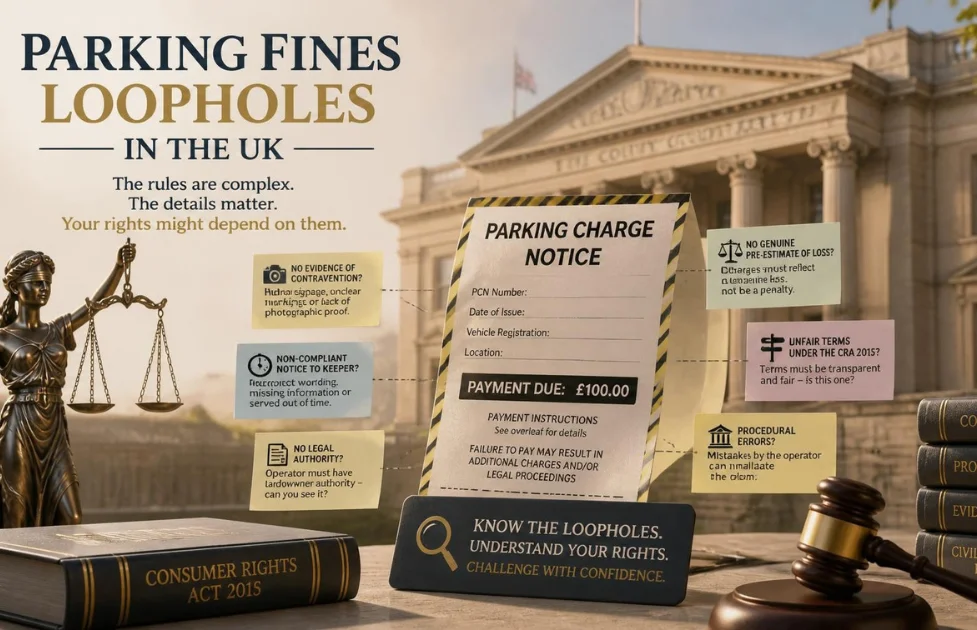
Parking fines loopholes are not secret tricks to avoid a valid charge. They are legal grounds that can expose an incorrect ticket. The right argument depends on who issued the notice and where you parked.
This guide provides general UK legal information rather than individual legal advice. Parking rules vary by notice type and jurisdiction. Check your notice and current official guidance before acting.
| Key point | What it means |
| Council ticket | Statutory Penalty Charge Notice with formal appeal rules |
| Private ticket | Parking Charge Notice based mainly on contract law |
| England council grace period | Ten minutes after permitted parking ends in qualifying spaces |
| Private keeper liability | Protection of Freedoms Act rules can matter in England and Wales |
| Main evidence | Photos, payment records, notices, timestamps, permits, repair records |
Direct answer: A parking ticket can be cancelled when the alleged breach did not happen, signs were inadequate, mandatory procedures failed, or liability was assigned incorrectly. Timing rules, grace periods, payment evidence, breakdowns, and operator mistakes may also help. Always match the argument to the ticket type and preserve evidence before appealing.
Key takeaways
- Identify whether the notice came from a council, police body, landowner, or private operator.
- Check signs, dates, payment records, photographs, and the exact contravention.
- Don’t assume the fourteen-day rule applies to every parking notice.
- Keep copies of appeals, rejection letters, receipts, screenshots, and supporting documents.
What does a parking “loophole” really mean?
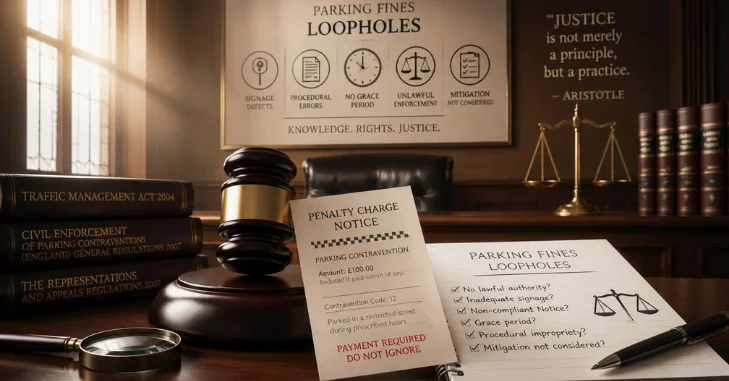
A parking fines loophole is usually a legal defence, exemption, or procedural failure. It does not erase a valid ticket because of a minor typo. The error must affect liability, procedure, evidence, or the alleged contravention.
Council PCNs follow statutory enforcement rules and formal appeal stages. Private charges usually arise from alleged breaches of contract on private land. Justic’s contract-law guide can help explain why clear terms and notice matter.
Parking Fines Loopholes: 9 Lawful Grounds Worth Checking
1. The alleged contravention did not happen
This is one of the clearest grounds for challenging a council PCN. Evidence may show you parked lawfully or stayed within the time limit. A permit, receipt, timestamp, or photograph can directly answer the alleged contravention.
2. Signs or road markings were unclear
Restrictions must be clear enough for motorists to understand. Faded markings, hidden signs, or conflicting instructions can support an appeal. Photograph the entrance, surrounding signs, road markings, and your vehicle position.
3. A council ignored the ten-minute grace period in England
English law protects qualifying vehicles after permitted parking time expires. A PCN should not be issued during the first ten minutes afterwards. The rule covers designated paid or free parking places under traffic orders.
It does not create ten free minutes on yellow lines. It also does not excuse never paying when payment was required. Check whether you were lawfully parked before the permitted period expired.
4. The authority made a procedural error
Councils must follow the correct statutory process when enforcing a PCN. Procedural impropriety can include defective notices or failure to properly consider representations. Charging the wrong penalty amount can also support an appeal.
In England, relevant formal representations have a statutory decision period. Current government guidance identifies fifty-six days as the maximum. Keep proof of when you served your representation.
5. A private operator missed keeper-liability requirements
Private operators can sometimes pursue registered keepers in England and Wales. Schedule 4 of the Protection of Freedoms Act 2012 sets detailed conditions. Timing and required wording can therefore matter.
Without a windscreen notice, a keeper-liability notice usually needs to be delivered within fourteen days. A windscreen notice uses a different timetable. The keeper notice normally arrives between day 29 and day 56.
A late notice can defeat keeper liability without erasing a possible driver claim. Schedule 4 applies to relevant private parking in England and Wales. Always check which person the operator is pursuing.
6. ANPR recorded entry and exit, but you paid before leaving
Private cameras usually record site entry and exit rather than parked time. The sector Single Code of Practice addresses delayed payment at camera-controlled sites. Version 1.1 took effect in February 2025.
Under that industry rule, you should not be charged if you paid in full before leaving. This can help when an app or signal delayed payment. Save receipts and screenshots showing the complete paid stay.
ANPR also involves personal-data processing and automated records. Data accuracy may matter when entry or exit records look wrong. Justic’s data protection principles guide provides useful background on data handling.
7. The payment machine failed with no reasonable alternative
A broken machine can support an appeal when no workable payment method existed. Citizens Advice identifies this as a possible ground for cancellation. Evidence is weaker if another clear payment method worked.
Take photographs of error messages and nearby payment instructions. Save app screenshots, call logs, bank attempts, and witness details. Explain the steps you took rather than making a bare assertion.
8. The notice targets the wrong person or vehicle
Liability rules differ between council and private notices. A sold vehicle, stolen vehicle, hire agreement, or cloned registration can change responsibility. Provide documents showing the correct ownership or control position.
Council PCNs usually attach liability to the vehicle owner, not the driver. Private notices require a separate driver-and-keeper analysis. Saying “I was not driving” does not cancel every notice.
9. Breakdown, disability, emergency, or compelling circumstances apply
Not every strong challenge is a strict statutory defence. Councils can consider compelling mitigation and should exercise discretion fairly. Breakdowns, medical events, disability-related delays, or emergencies may justify cancellation.
Private operators also have appeal standards covering several mitigating situations. Results depend on the facts, evidence, and the operator’s current rules. Repair invoices, medical records, or roadside-assistance records can strengthen the case.
Council ticket or private ticket: use the correct route
| Ticket type | Typical issuer | First step | Next independent stage |
| Council PCN in England or Wales | Local authority | Informal challenge or formal representation | Traffic Penalty Tribunal or London Tribunals |
| Private Parking Charge Notice | Parking operator | Appeal to operator | POPLA for BPA members or IAS for IPC members |
| Northern Ireland PCN | Department for Infrastructure | Challenge, then representation | Northern Ireland Traffic Penalty Tribunal |
| Scotland council notice | Local authority | Follow the stated process | First-tier Tribunal for Scotland after rejection |
The appeal routes differ materially between ticket types and jurisdictions. GOV.UK guidance says England and Wales council PCNs can usually be challenged within 28 days. Private appeal deadlines depend on the operator and trade association.
Broader UK legal advice resources can help when the notice raises unfamiliar issues. Complex disputes may need individual advice rather than a template. Justic’s Find A Lawyer resources can help you explore professional support.
What changes across the UK?
Parking enforcement differs across the four UK nations. England has a statutory ten-minute grace rule for qualifying council parking places. Scotland and Northern Ireland use different public enforcement frameworks.
Schedule 4 keeper liability applies to relevant private parking in England and Wales. Scotland does not use that same statutory keeper-liability route. Northern Ireland also has its own public PCN process through the Department for Infrastructure.
The 2026 private-parking law update
The statutory government code for private parking is not yet in force. On 18 September 2026, ministers said they intended to lay it in autumn. The withdrawn 2022 code should not be treated as current binding rules.
The voluntary industry code remains important for accredited operators. Its current version is 1.1, with transition rules for older sites. The CMA also raised concerns about private appeals and added charges in July 2026.
Evidence to collect before you appeal
Good evidence turns a general complaint into a focused challenge. Collect material before signs change, machines are repaired, or records disappear. Keep originals and send copies where possible.
- Clear photographs of signs and road markings.
- A wider photograph showing the vehicle and surrounding signs.
- The original notice and every later letter.
- Tickets, app receipts, bank records, and timestamps.
- Permit, Blue Badge, hire, sale, or ownership documents.
- Breakdown reports, medical evidence, or witness statements.
- Screenshots showing failed payments or app errors.
- Copies of every appeal and proof of submission.
What not to do
Do not invent facts, alter documents, or submit false evidence. False representations can create separate legal problems and destroy credibility. Base the challenge on genuine facts you can support.
Do not ignore a notice because somebody online calls it unenforceable. Private operators can pursue unpaid charges through civil courts where appropriate. Council penalties can also escalate after missed deadlines.
Paying can sometimes end your appeal rights, depending on the notice. Read the instructions before choosing between payment and challenge. Ask the issuer if you are uncertain about payment effects.
Frequently Asked Questions
Do parking fines loopholes work in the UK?
Yes, when the “loophole” is a genuine legal ground or factual defence. Examples include unclear signs, wrong liability, procedural failures, or protected grace periods. A weak technical complaint will not automatically cancel a valid charge.
Is a private parking charge the same as a council fine?
No, even though they look and sound similar. Council PCNs come from statutory enforcement powers, while private charges usually rely on contract law. The appeal routes and liability rules are different.
What if a private parking notice arrives after fourteen days?
The answer depends on how the notice was issued and who is pursued. In England and Wales, late service can defeat Schedule 4 keeper liability. It does not necessarily extinguish a claim against an identified driver.
Can I ignore a private parking ticket?
Ignoring it is risky and rarely improves your position. A private operator may send debt correspondence or issue a civil claim. Challenge it promptly when you have a genuine defence.