

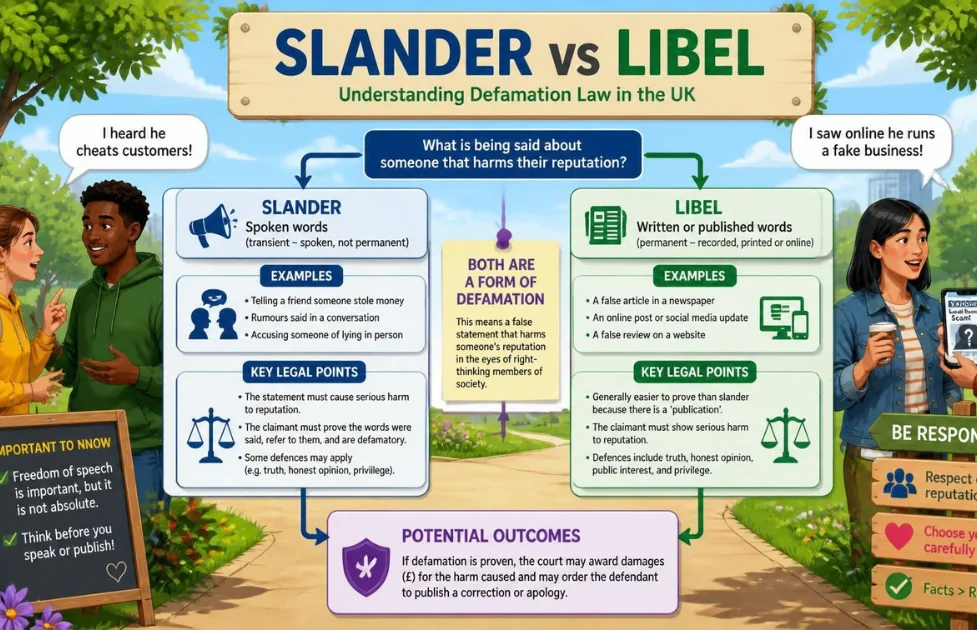
People often use slander and libel as interchangeable labels, but UK law is more precise. The slander vs libel distinction matters most in England and Wales. It can affect proof, damages, evidence, and how a court classifies the publication.
Libel usually covers defamation published in a permanent or recorded form, such as an article, post, email, or broadcast. Slander usually covers transient defamation, especially unrecorded speech. In England and Wales, both must meet the serious-harm threshold. Scotland does not use the same libel-versus-slander distinction.
| Key point | Libel | Slander |
| Usual form | Written, recorded, or otherwise permanent | Spoken or otherwise temporary |
| Common examples | Articles, emails, social posts, recorded videos | Conversations, meetings, unrecorded remarks |
| Special financial loss | Usually not required separately | May be required in some cases |
| Online content | Usually falls within this category | Less common online |
| England and Wales | Governed partly by the Defamation Act 2013 | Same serious-harm threshold applies |
| Scotland | No equivalent legal distinction | No equivalent legal distinction |
Key Takeaways
- England and Wales distinguish permanent publications from temporary spoken statements.
- A social media post will usually be treated as a permanent publication.
- An unrecorded spoken allegation will usually fall into the temporary category.
- Broadcast speech can be treated as publication in permanent form.
- Some spoken claims require proof of specific financial loss.
- England, Wales, Scotland, and Northern Ireland do not share one identical statutory framework.
- Defamation deadlines can be short, so early legal advice may matter.
Slander vs Libel: What Is the Main Difference?
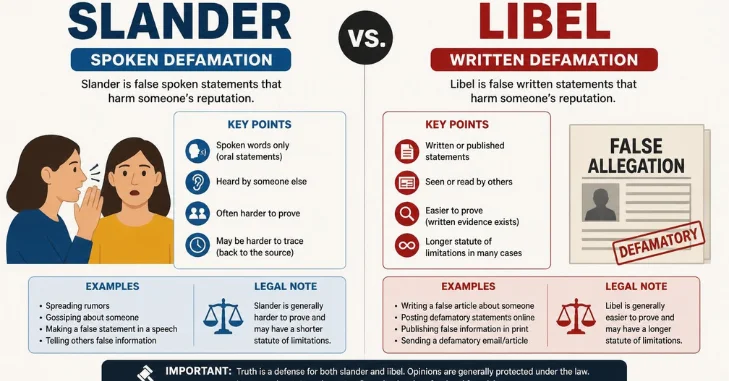
The slander vs libel traditional difference concerns how the damaging statement reaches another person. A permanent or recorded publication generally falls within the written category. A temporary spoken statement generally falls within the oral category.
That rule is more flexible than “written versus spoken” suggests. Recorded speech can have the legal characteristics of a permanent publication. Broadcast statements have also been treated as permanent publications under legislation.
The distinction matters because ordinary spoken claims can involve an extra requirement called special damage. In this context, special damage generally means financial loss caused by the words. The rule has several important exceptions.
What Counts as Libel in England and Wales?
Libel normally concerns defamatory material published in a permanent form. The material does not need to appear in a newspaper or book. Modern digital communications can also satisfy this characteristic.
Common examples include:
- newspaper and magazine articles.
- website pages and blog posts.
- Facebook, X, Instagram, or LinkedIn posts.
- emails and many text messages.
- recorded podcasts and videos.
- photographs containing defamatory material.
- television or radio broadcasts.
The publication must reach somebody other than the person concerned. Sending an allegation only to its subject may not meet that publication requirement. Wider distribution can also influence the evidence about reputational harm.
What Counts as Slander in England and Wales?
Slander generally concerns defamatory words communicated in a temporary form. An unrecorded statement during a conversation is the clearest example. Remarks made during a meeting may also fall into this category.
Ordinary slander can require proof of financial loss before damages become available. Yet the law recognises exceptions where that proof is unnecessary. One concerns words damaging a person in their profession, office, trade, or business.
Another traditional exception can concern allegations of sufficiently serious criminal conduct. Section 14 of the Defamation Act 2013 removed two historic exceptions, so older guidance listing more categories no longer reflects the current law. These rules are technical and can depend on the exact words used. Justic’s Find a Lawyer section can help you instruct a solicitor to assess whether a particular allegation falls within an exception.
What Must Someone Prove in a Defamation Claim?
A claimant in England and Wales needs more than an insulting or unpleasant statement. The legal test examines meaning, publication, identification, and resulting reputational harm. Context can change how apparently simple words are understood.
Important issues usually include:
- Defamatory meaning: Would the words tend to lower the claimant’s reputation?
- Identification: Did the statement refer to the claimant, directly or indirectly?
- Publication: Was the statement communicated to at least one other person?
- Serious harm: Has the publication caused, or is it likely to cause, serious reputational harm?
- Financial loss: Does the type of spoken claim require proof of special damage?
Section 1 of the Defamation Act 2013 introduced the serious-harm requirement in England and Wales. Trading bodies must show serious financial loss or its likelihood. The Supreme Court has confirmed that courts examine the publication’s real impact and surrounding facts.
This means a technically defamatory remark does not automatically support a successful claim. Its audience, reach, credibility, and consequences can all matter. A minor insult heard by one sceptical listener may present a different case.
Permanent and Transient Statements Compared
| Issue | Permanent publication | Transient publication |
| Typical medium | Print, websites, social posts, recordings | Unrecorded speech |
| Evidence | Screenshots, copies, recordings, analytics | Witness evidence, notes, surrounding records |
| Continued availability | Often remains accessible | Usually ends once spoken |
| Financial-loss rule | Usually actionable without separate special damage | Special damage can be required |
| Digital relevance | High | Lower |
| Serious-harm test in England and Wales | Applies | Applies |
The medium does not decide whether a claimant will win. Courts still examine the statement’s meaning and its effect. Available defences can also defeat an otherwise arguable claim.
Does Social Media Count as Libel?
A defamatory social media post will usually have the characteristics of permanent publication. Posts can be copied, shared, searched, and preserved. Even deleted material may survive through screenshots or reposts.
Private online messages can also create legal issues when another person receives them. A huge public audience is not always required for publication. Audience size can still be important when assessing serious harm.
Anyone facing damaging online material should preserve evidence before requesting deletion. Screenshots should show the content, account, date, and surrounding context. Links and engagement information can also help establish publication and reach.
What Defences Can Apply?
A statement can harm somebody’s reputation without creating legal liability. England and Wales recognise several important statutory defences. Their application depends on the facts and the publication’s meaning.
Key defences include the following.
- Truth: the defendant shows that the defamatory imputation was substantially true.
- Honest opinion: the statement satisfies the statutory requirements for protected opinion.
- Public interest: publication was on a public-interest matter and the required belief was reasonable.
- Privilege: certain reports, proceedings, and communications can receive absolute or qualified protection.
The Defamation Act 2013 contains the principal statutory defences for England and Wales. Truth does not require every minor detail to be correct. The substantial meaning of the allegation is central.
Privilege can be especially important for court proceedings and certain protected reports. Qualified privilege can sometimes be defeated by evidence of malice. The exact protection depends on the circumstances and type of publication.
How Do the Rules Differ Across the UK?
England and Wales retain the traditional distinction between the two forms of defamatory publication. The Defamation Act 2013 introduced the statutory serious-harm threshold there. It also created or restated several major defences.
Scotland takes a different approach to terminology. Scots law does not recognise the same legal distinction between oral and written forms. The Scottish Law Commission expressly describes both forms as defamation.
Scotland now operates under the Defamation and Malicious Publication (Scotland) Act 2021. That legislation includes its own serious-harm requirement. It should not be treated as an extension of England’s 2013 Act.
Northern Ireland also has a separate legal framework. The Defamation Act (Northern Ireland) 2022 introduced statutory defences including truth, honest opinion, and public interest. Advice written only for England and Wales should not automatically be applied there.
What Evidence Should You Preserve?
Defamation disputes often turn on exactly what was communicated and who received it. Evidence can disappear quickly, especially on social platforms. Preserving original material can therefore be important before contacting the publisher.
Useful evidence can include the following.
- screenshots showing complete posts and comments.
- copies of emails, letters, or messages.
- audio or video recordings lawfully available to you.
- names and contact details of witnesses.
- dates, times, and locations of spoken remarks.
- web addresses and archived copies.
- evidence showing readership, sharing, or engagement.
- documents showing lost work, customers, or income.
For spoken allegations, witness evidence can be particularly significant. Notes made close to the event can help preserve details. Financial records may matter when special damage must be established.
How Long Do You Have to Bring a Claim?
Defamation claims have unusually short limitation periods. In England and Wales, the general period is one year from accrual. Courts have limited powers to disapply that period in appropriate circumstances.
Scotland’s 2021 reforms also reduced its general limitation period to one year. Northern Ireland likewise has a one-year statutory period for libel or slander claims. The precise accrual and extension rules differ between jurisdictions.
Waiting for negotiations to finish can therefore create risk. Anyone considering proceedings should check the applicable deadline early. A limitation issue can be decisive even where the underlying complaint appears strong.
What Should You Do If Your Reputation Has Been Harmed?
Start by preserving the publication and recording where it appeared. Avoid escalating the dispute through angry public responses. A measured correction, removal request, or legal letter may sometimes resolve matters without proceedings.
You can review Justic’s Legal Advice resources for broader guidance on legal disputes. Funding arrangements vary, so review the guidance on no win, no fee solicitors before assuming a case qualifies.
Defamation disputes can involve reputation, free expression, evidence, and strict procedural rules. The correct approach depends on the statement and the relevant UK jurisdiction. Individual legal advice is sensible when publication has caused serious personal or commercial consequences.
The Key Point
The spoken-versus-written shortcut is useful, but it does not tell the whole story. Format, publication, serious harm, financial loss, and available defences can all change the result. The correct rules also depend on which UK jurisdiction governs the dispute.
If reputational harm is serious, preserve the evidence and check the limitation period immediately. Consider advice from a solicitor experienced in media and reputation disputes. Early advice can clarify whether a claim, defence, correction, or negotiated resolution is appropriate.
Frequently Asked Questions
What does slander vs libel mean in UK law?
In England and Wales, the first usually concerns temporary spoken words. The second usually concerns written, recorded, or otherwise permanent publications. Scotland does not use this same legal distinction.
Is a social media post libel?
A social media post will normally be treated as a permanent publication in England and Wales. Its reach can affect evidence of serious harm. A post does not become actionable merely because it is offensive.
Can spoken words be treated as libel?
Yes, the medium is more important than whether a human voice was involved. Recorded or broadcast speech can be treated differently from ordinary conversation. Broadcasting has long been treated as permanent publication for these purposes.
Do you always need to prove financial loss after spoken defamation?
No, because several legal exceptions can remove the special-damage requirement. Statements damaging someone in their profession or business are one important example. Ordinary spoken claims outside an exception may still require financial loss evidence.
What if the damaging statement is true?
Substantial truth is a statutory defence in England and Wales. Northern Ireland also has a statutory truth defence under its 2022 Act. Scotland has its own statutory framework, so jurisdiction should always be checked.

