In tort law, liability is usually imposed on the person who directly causes harm. However, there are situations in which one individual or organization can be held responsible for another’s wrongful actions. This legal concept is known as vicarious liability in tort. There is more on this in Accidental Manslaughter 2026.
The doctrine plays a significant role in modern legal systems by helping ensure that injured parties receive compensation, especially when the wrongdoer is acting on behalf of an employer or principal. It also encourages organizations to supervise their employees properly and maintain safe practices.
Understanding how this principle works is essential for business owners, employees, law students, and anyone interested in civil law. This article explores its meaning, key principles, practical examples, and legal implications.
| Aspect | Key Point | Example |
| Definition | Responsibility for another person’s wrongful act. | Employer liable for employee negligence. |
| Employment Relationship | Usually applies to employees, not contractors. | Company driver causes harm. |
| Scope of Employment | Act must occur during work duties. | Delivery accident during work hours. |
| Common Torts | Negligence, assault, defamation, trespass. | Security guard unlawfully detains a customer. |
| Real-Life Applications | Transportation, healthcare, retail sectors. | Nurse’s error or waiter injuring a customer. |
| Exceptions | Personal acts or independent contractors. | Employee involved in a private dispute. |
| Benefits | Protects victims and promotes accountability. | Better supervision and training. |
| Business Risks | Legal claims and financial losses. | Compensation payments and legal fees. |
| Legal Importance | Ensures fair compensation for victims. | Courts hold employers accountable when appropriate. |
What Is Vicarious Liability?

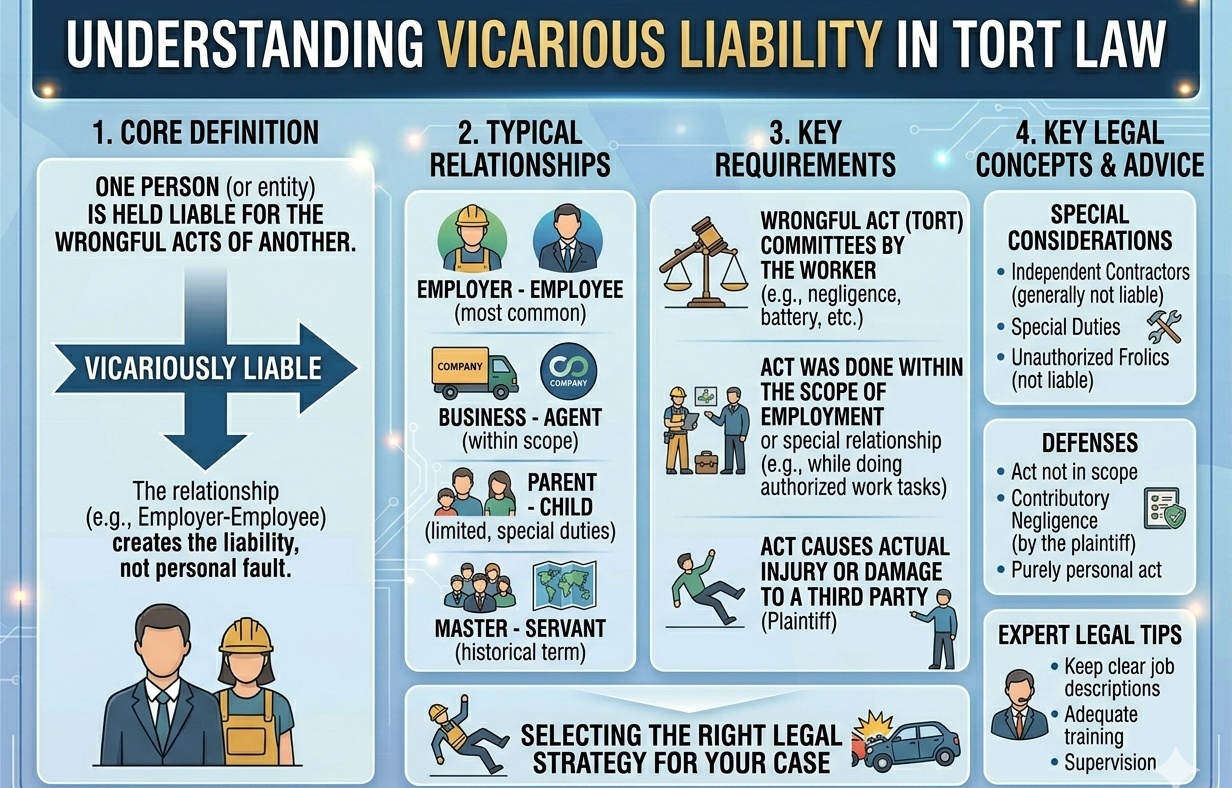
Vicarious liability is a legal principle under which one party is held responsible for the wrongful conduct of another, even though the latter did not personally commit the act. Most commonly, employers may be held accountable for torts committed by employees while performing their job duties.
The liability arises from the parties’ relationship rather than from direct wrongdoing. For example, if a delivery driver negligently causes a road accident while making deliveries for a company, the employer may also be legally responsible for the resulting damages.
Why Does This Legal Doctrine Exist?
The law recognizes this principle for several practical reasons:
- To ensure victims receive fair compensation
- To encourage responsible supervision of employees
- To promote workplace safety
- To distribute financial risks to organizations that benefit from employees’ work
- To maintain public confidence in business operations
Without this doctrine, injured parties might struggle to recover damages from individuals who lack sufficient financial resources.
Key Principles Behind Employer Responsibility

Several important elements must usually be present before responsibility can be transferred from an employee to an employer.
Existence of an Employment Relationship
The wrongdoer must generally be an employee rather than an independent contractor.
Courts often examine factors such as:
- Degree of control exercised by the employer
- Method of payment
- Working arrangements
- Nature of the job
The closer the relationship resembles employment, the more likely it is that liability will arise.
Wrongful Act Must Be a Tort
The employee must have committed a recognized tort, such as:
- Negligence
- Assault
- Defamation
- Trespass
- Nuisance
If no tort has occurred, the doctrine generally does not apply.
Act Must Occur Within the Scope of Employment
One of the most important requirements is that the wrongful conduct must be connected to the employee’s job duties. Courts often ask whether the employee was performing assigned tasks or activities closely related to their employment at the time of the incident.
Common Situations Where Vicarious Liability in Tort Arises

The doctrine applies in many real-world scenarios.
Road Accidents
A company driver causes an accident while delivering products to customers. Because the driver was performing work-related duties, the employer may share responsibility.
Medical Negligence
Hospitals can sometimes be held liable for negligent actions committed by doctors, nurses, or other staff members during patient treatment.
Workplace Misconduct
If an employee assaults a customer while carrying out work duties, the employer may face legal claims depending on the circumstances.
Security Services
Security guards who unlawfully detain or injure someone while performing their assigned tasks can expose their employer to liability.
Comparison of Key Requirements
| Requirement | Description | Importance |
| Employment Relationship | A recognized employer-employee connection exists | Establishes legal responsibility |
| Tortious Conduct | A civil wrong has occurred | Creates the basis for a claim |
| Scope of Employment | The act is linked to job duties | Determines whether liability transfers |
| Damage or Injury | Victim suffers loss or harm | Required for compensation |
| Causal Connection | The wrongful act caused the damage | Supports legal recovery |
Real-Life Examples

Example 1: Delivery Driver Accident
A logistics company employs a driver to transport goods. While making deliveries, the driver negligently runs a red light and collides with another vehicle. Because the driver was performing assigned duties, the company may be held liable for the resulting injuries and property damage.
Example 2: Restaurant Employee Incident
A restaurant employee spills hot coffee on a customer due to careless handling. Since the employee was performing job-related tasks, the business may be required to compensate the injured customer.
Example 3: Hospital Staff Negligence
A nurse administers incorrect medication during a hospital shift, causing harm to a patient. The healthcare institution may face legal liability because the negligent act occurred during the course of employment.
When Employers May Avoid Responsibility
There are several situations in which employers may not be held responsible for the wrongful actions of others. One common exception occurs when an employee acts solely for personal reasons unrelated to their job duties.
In such cases, liability may not transfer to the employer because the conduct falls outside the scope of employment. For example, if an employee leaves work and intentionally harms someone during a private dispute, the employer is generally not responsible for the resulting damages.
Similarly, organizations are usually not liable for the actions of independent contractors, as these individuals typically exercise greater control over how they perform their work. However, certain exceptions may apply depending on local laws and the nature of the activity involved.
Legal Implications for Businesses
Understanding this doctrine is essential for organizations of all sizes.
Potential consequences include:
- Financial compensation claims
- Legal expenses
- Reputational damage
- Increased insurance costs
- Regulatory scrutiny
To reduce risks, businesses often implement training programs, supervision procedures, workplace policies, and insurance coverage.
Importance in Modern Tort Law
The concept remains a cornerstone of modern civil liability systems. It balances the interests of injured individuals and organizations by ensuring that victims have a realistic avenue for compensation.
Courts continue to adapt the doctrine to evolving workplaces, including remote work environments and complex corporate structures. As businesses become more interconnected, determining responsibility remains an important legal challenge.
Conclusion
Vicarious liability in tort is a fundamental legal principle that extends responsibility for certain wrongful acts beyond the individual who directly caused the harm. It most commonly arises in employer-employee relationships when a tort is committed during the course of employment.
By promoting accountability, victim compensation, and workplace oversight, this doctrine serves an important role in modern legal systems. Businesses that understand and manage these risks are better positioned to avoid disputes and maintain compliance with legal standards.
If you want to read an interesting article about it, explore our Legal Advice category.
Frequently Asked Questions
It is a legal doctrine that holds one party, usually an employer, responsible for the tortious acts of another person, typically an employee, when those acts occur within the scope of employment.
Generally, no. Employers are usually not responsible for the actions of independent contractors, although certain exceptions may exist.
Common examples include negligence, assault, defamation, trespass, and other civil wrongs committed in the course of work-related activities.
Courts examine whether the conduct was closely connected to the employee’s assigned duties and performed in the course of employment.