

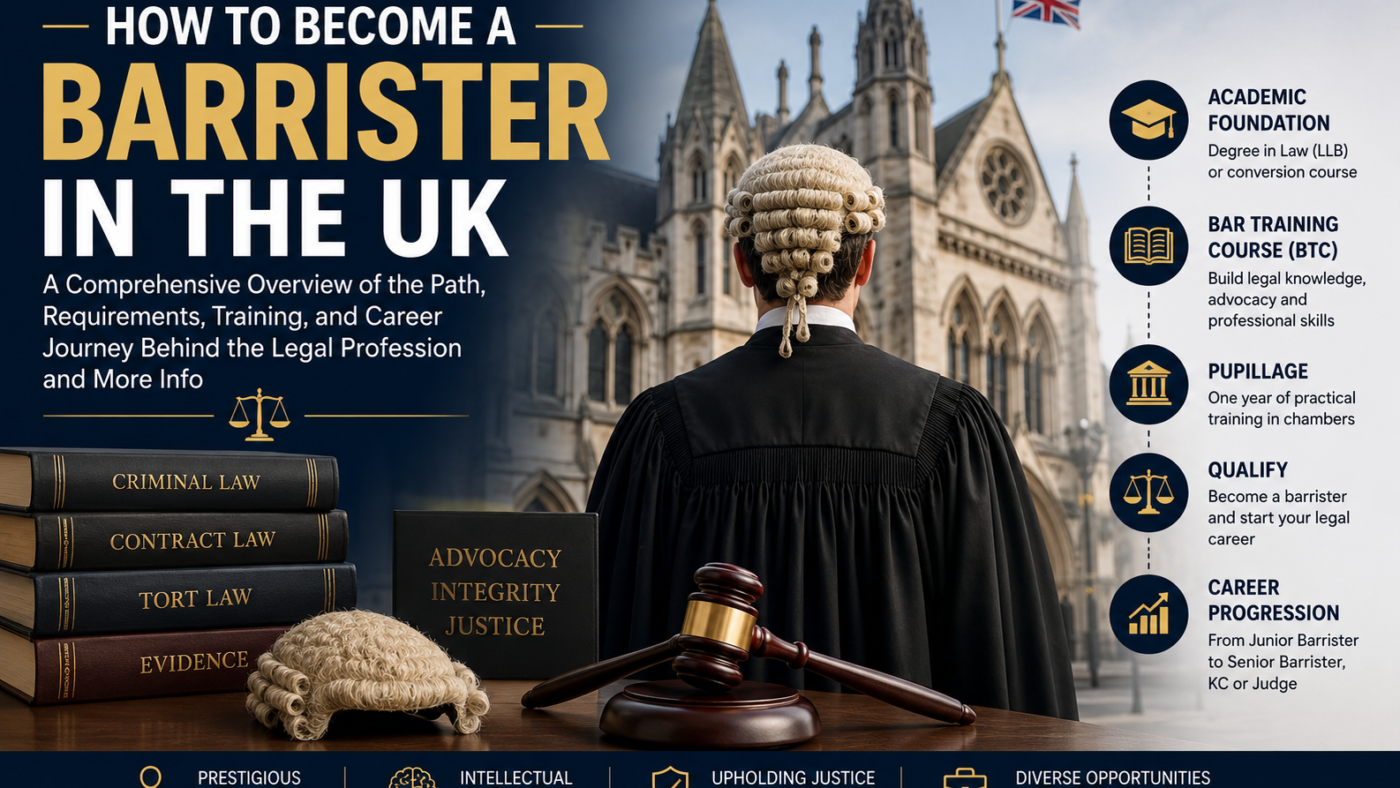
How to Become a Barrister in the UK is a structured legal career that requires strong academic qualifications, training, and courtroom experience. Barristers specialise in courtroom advocacy, representing clients in higher courts through legal arguments and witness examination.
Solicitors instruct barristers and provide legal research, interpretation of law, and expert opinions for complex cases. Their career progresses from training and pupillage to roles such as Junior Barrister, Senior Barrister, KC, or Judge.
Barristers earn varying incomes, from modest pupillage pay to very high senior earnings. However, the path is highly competitive, requiring strong academics, financial investment, and resilience under pressure while maintaining high ethical standards.
| Section | Key Information |
| Who is a Barrister? | A legal professional specialising in courtroom advocacy, representing clients in higher courts and providing expert legal advice. |
| Main Role | Presenting legal arguments, cross-examining witnesses, drafting legal documents, and offering specialist legal opinions. |
| Career Progression | Junior Barrister → Experienced Barrister → King’s Counsel (KC) → Judge or Legal Consultant. |
| Salary Range | Pupillage (modest stipend), Junior Barrister (moderate income), Experienced Barrister (high income), KC (very high earnings). |
| Education Pathway | LLB degree or non-law degree + conversion course (PGDL) if required. |
| Professional Training | Bar Training Course (BTC) followed by one-year pupillage in chambers. |
| Inns of Court | Inner Temple, Middle Temple, Gray’s Inn, Lincoln’s Inn (mandatory membership). |
| Regulatory Body | Bar Standards Board (BSB) – regulates training, ethics, and professional conduct. |
| Core Duties | Legal advocacy, case preparation, legal research, drafting documents, and advising solicitors/clients. |
| Key Challenges | Highly competitive pupillage, high education costs, academic pressure, and emotional stress. |
| Required Skills | Communication, analytical thinking, legal reasoning, public speaking, and resilience. |
| Future Outlook | Increasing use of AI and digital courts, but strong demand for human advocacy remains. |
How to Become a Barrister in the UK? Working Process

A barrister is a legal professional in the UK who specialises in courtroom advocacy and providing expert advice on complex legal cases. They represent clients in higher courts by presenting arguments and cross-examining witnesses before a judge or jury.
Barristers are usually instructed by solicitors, who prepare the case and refer it when specialist legal representation is required. In addition to courtroom work, barristers also research case law, interpret legislation, and draft detailed legal opinions to support legal strategy.
Career Progression of a Barrister
A barrister’s career evolves with experience and reputation.
Career Levels
- Junior Barrister
- Experienced Barrister
- King’s Counsel (KC)
- Judge or legal consultant
King’s Counsel (KC)
- This is a senior rank awarded to highly experienced barristers known for excellence in advocacy.
Salary Expectations
- Earnings vary depending on experience and practice area.
Approximate Earnings
- Pupillage: modest stipend
- Junior Barrister: moderate income
- Experienced Barrister: high income potential
- KC barrister: very high earnings
How to Become a Barrister UK: Complete Step-by-Step Pathway?

Becoming a barrister in the UK follows a structured pathway designed to build strong legal knowledge and courtroom skills. It begins with completing an LLB or a non-law degree followed by a conversion course, and then joining one of the Inns of Court.
Aspiring barristers complete the Bar Training Course (BTC) to build core legal and advocacy skills, followed by a one-year pupillage for hands-on courtroom training. After completing both stages, they qualify to practise as fully trained barristers in the UK. You might also like Parking Fines Loopholes in the UK.
Step 1: Complete an Undergraduate Degree
The first step in how to become a barrister in the UK is obtaining a bachelor’s degree.
Degree Options
- LLB Law degree (most direct route)
- Any non-law degree (followed by conversion course)
Step 2: Complete a Law Conversion Course (If Required)
Non-law graduates must complete a Postgraduate Diploma in Law (PGDL) or equivalent conversion course.
Purpose of Conversion Course
- Introduces core legal principles
- Builds analytical reasoning skills
- Prepares students for Bar training
Step 3: Join an Inn of Court
All aspiring barristers must join one of the four Inns of Court:
- Inner Temple
- Middle Temple
- Gray’s Inn
- Lincoln’s Inn
Challenges in Becoming a Barrister

Becoming How to Become a Barrister in the UK is a highly competitive and demanding process that requires strong commitment, academic excellence, and resilience. One of the biggest challenges is securing a pupillage, as it is extremely competitive with far more applicants than available positions.
Candidates must maintain high academic performance throughout their studies, as small mistakes can affect future opportunities. Another challenge is the high cost of legal education and the uncertainty of securing a paid pupillage.
The profession is mentally and emotionally demanding, involving complex cases, tight deadlines, and high-pressure courtroom work. Despite this, it is highly rewarding for individuals who are confident, disciplined, and able to think clearly under pressure.
Core Duties of a Barrister
The core duties of a barrister involve providing expert legal representation and advice in complex court cases. They present arguments in court and examine or cross-examine witnesses using strong legal reasoning and evidence.
Barristers draft legal documents, prepare case strategies, and advise solicitors and clients on complex legal issues. They also conduct legal research, analyse case law, and simplify arguments for judges and juries.
Barristers must remain independent, follow strict ethical standards, and act in the interests of justice rather than personal gain. They also negotiate settlements outside court and play a key role in ensuring fairness, accuracy, and integrity within the legal system.
Step 4: Bar Training Course (BTC)
The Bar Training Course is one of the most important stages in learning to become a barrister in the UK.
Key Focus Areas
- Advocacy and courtroom skills
- Drafting legal documents
- Case preparation techniques
- Professional ethics and conduct
Regulatory Authority: Bar Standards Board (BSB)
The Bar Standards Board (BSB) is the independent regulator responsible for overseeing barristers in England and Wales. It sets standards for education, training, professional conduct, and ethics to ensure barristers maintain competence, integrity, and professionalism.
The BSB approves Bar training providers, regulates the Bar Training Course, and sets qualification standards for aspiring barristers. It also ensures qualified barristers follow professional rules on client care, conduct, and confidentiality.
It can investigate complaints, impose sanctions, and take disciplinary action for misconduct or poor practice. It also promotes access to justice and diversity, helping maintain fairness, transparency, and public trust in the legal profession.
Future of the Barrister Profession in the UK
The future of How to Become a Barrister in the UK is evolving due to technological advancements, changing client expectations, and legal reforms. Digital transformation, including virtual hearings and AI-assisted legal research, is increasingly shaping everyday legal practice.
Technology is improving efficiency but requires barristers to develop stronger digital skills, while demand for specialised legal expertise continues to grow. However, human advocacy will remain essential in complex cases, ensuring barristers continue to uphold justice and legal integrity.
Conclusion
Know how to Become a Barrister in the UK is a challenging yet rewarding career that requires strong academic qualifications and structured training. It involves completing qualifications, Bar training, and pupillage to gain practical courtroom experience.
Each stage builds essential skills in advocacy, legal reasoning, and ethical decision-making needed for success in the profession. Despite high competition, costs, and pressure, the barrister profession offers strong career prospects, intellectual growth, and professional prestige.
Barristers can specialise in different areas of law and progress to senior roles such as King’s Counsel or a Judge. Although demanding, it is a highly respected career that offers strong impact and fulfilment within the UK legal system.
Want to know about Graduate Diploma in Law (GDL): A Comprehensive Overview of Legal Conversion Courses, Skills, Careers, Entry Requirements, Admissions, and More info Check out our Legal Advice category.
FAQs
In the UK, experienced self-employed barristers with over 10 years of practice typically earn between £100,000 and £300,000, while top barristers may earn £500,000 to £1 million. Employed barristers generally earn around £90,000 to £150,000 or more, depending on their role and expertise.
The salary range for individuals with more than ten years of experience is £65,000 to £1,000,000. People who live in London and other large cities will often earn more as well. A profession as a barrister offers enormous income possibilities.
In the UK, becoming a qualified barrister usually takes five years. This is divided into three years for an academic degree, one year for the Bar Course, and one year for pupillage.

