If persistent ringing or other ear noise developed because of unsafe working conditions, an accident, or another party’s negligence, tinnitus compensation claims may provide a route to recover damages. Success depends on proving the medical condition, its likely cause, legal responsibility, and the losses you have suffered.
The rules can become more complicated when symptoms develop gradually after years of noise exposure. This guide explains the evidence, current 2026 compensation guidance, time limits, and special rules that can apply to military personnel. For a closer look at this, see GP Negligence Claims in the UK.
| Key point | What to know |
| Can you make a claim? | Potentially, if another person or organisation’s negligence caused or materially worsened your condition |
| Typical England and Wales time limit | Usually three years from the date of injury or the later “date of knowledge” |
| 2026 general damages guidance | Current Judicial College brackets run from up to £9,260 for slight symptoms alone to a band of £39,250 to £60,160 for severe symptoms with noise-induced hearing loss. |
| Useful evidence | Medical records, hearing tests, exposure records, employment documents, witness evidence, and proof of financial losses |
| Military cases | The Armed Forces Compensation Scheme or War Pension Scheme may apply instead of, or in addition to, other legal routes. |
The compensation figures above come from the 18th edition of the Judicial College Guidelines, published in April 2026. They are guidelines rather than fixed tariffs, so the facts and medical evidence in each case matter.
You may be able to claim compensation when persistent ear noise was caused by negligent workplace exposure, an accident, or another avoidable event. A viable case typically requires medical evidence, proof of the cause of the injury, evidence of legal responsibility, and compliance with the relevant deadline. Compensation also depends on the severity of the condition and any proven financial losses.
Who Can Make Tinnitus Compensation Claims?
A claim may be possible when someone who owed you a legal duty failed to take reasonable care, and that failure caused your hearing condition. An employer can also be answerable for harm caused by its own staff, a principle set out in our guide to vicarious liability in tort.
Workplace noise is one common example. The Control of Noise at Work Regulations 2005 require employers to assess noise risks, reduce harmful exposure, provide suitable protection where needed, and arrange health surveillance in appropriate cases. The Health and Safety Executive sets lower and upper exposure action values at 80 dB(A) and 85 dB(A).
Other cases can arise after a single explosive or exceptionally loud event, a road traffic accident, or an injury involving the head or ears. The important issue is not simply when the symptoms appeared. You must also establish a credible link between the incident or exposure and your condition.
Tinnitus means hearing sounds that do not come from an outside source. People may experience ringing, buzzing, humming, hissing, whooshing, or throbbing. It may affect one or both ears and can be intermittent or persistent.
Health comes first. NHS guidance advises seeing a GP when symptoms are regular, worsening, or affecting sleep or concentration. Tinnitus after a head injury, or symptoms accompanied by sudden hearing loss, facial weakness, or severe vertigo, may require urgent medical attention.
What Evidence Makes a Hearing-Damage Claim Stronger?
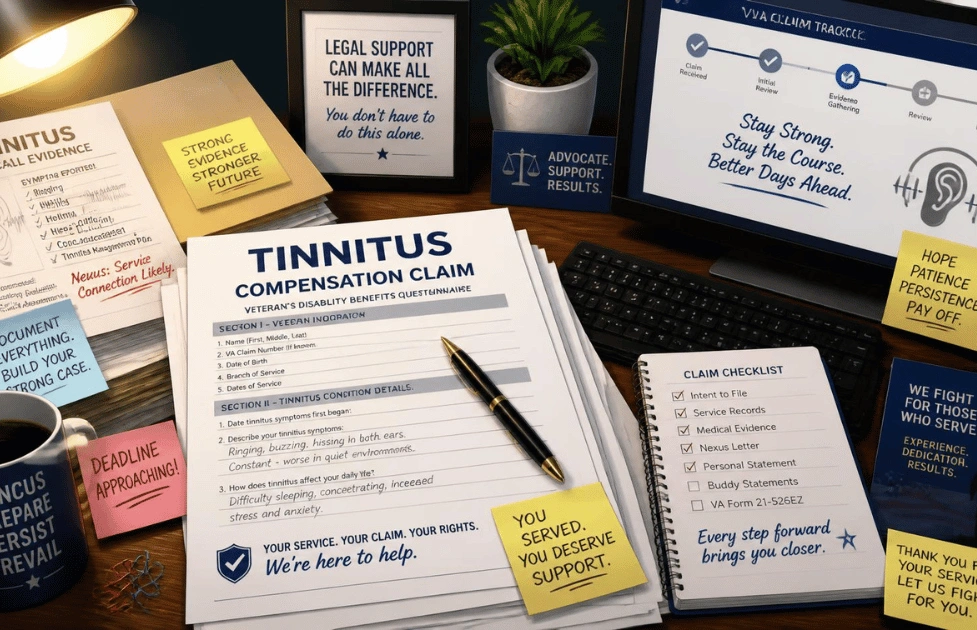
A solicitor will usually need evidence showing both the medical condition and how the defendant may have caused it. Useful material can include:
- GP, ENT, or audiology records
- an audiogram or other hearing-test results
- a clear timeline of noisy jobs, accidents, or harmful events
- employment records showing your role and period of exposure
- documents about hearing protection, training, or workplace noise assessments
- accident or incident reports
- statements from colleagues or other witnesses
- wage records and receipts showing financial losses
- notes explaining how the symptoms affect sleep, work, concentration, and daily life
Medical experts are often needed to assess hearing damage and determine whether the history of exposure is consistent with the symptoms.
A former employer going out of business does not always end the possibility of a workplace claim. In some cases, the relevant historic liability insurer can still be identified. Whether this is possible depends on the available records and circumstances so that specialist advice may be helpful.
How Much Are Tinnitus Compensation Claims Worth in 2026?

There is no single average payout that reliably predicts what an individual will receive. Courts and lawyers consider factors such as severity, hearing loss, prognosis, effects on work, and the impact on normal life.
The 18th edition of the Judicial College Guidelines was published on 9 April 2026. For hearing injuries, the current guidance includes the following figures.
| Injury description | 2026 guideline range |
| Slight symptoms alone, or slight noise-induced hearing loss alone | Up to £9,260 |
| Slight or occasional symptoms with slight hearing loss | £9,720 to £16,640 |
| Mild symptoms alone, or mild hearing loss alone | Around £15,480 |
| Mild symptoms with some hearing loss | £16,640 to £19,680 |
| Moderate symptoms with hearing loss, or moderate-to-severe symptoms or hearing loss alone | £19,680 to £39,250 |
| Severe symptoms with noise-induced hearing loss | £39,250 to £60,160 |
These figures relate to general damages, which compensate for the injury itself and its effect on quality of life. The guidelines do not guarantee an award within a particular bracket.
A settlement may also include compensation for recoverable financial losses. Depending on the case, these can include lost earnings, treatment expenses, hearing aids, travel costs, care costs, or other reasonable expenses incurred as a result of the injury. Evidence such as payslips, invoices, and receipts helps establish those losses.
The figures above are most useful for claims valued using the Judicial College Guidelines in England and Wales. Different legal systems and procedures apply in Scotland and Northern Ireland.
What Is the Time Limit for a Claim?
For personal injury proceedings in England and Wales, the usual limitation period is three years. Under section 11 of the Limitation Act 1980, that period can run from the date of injury. It can also run from the later date on which the claimant first had the relevant “knowledge” of the injury and its link to the defendant.
That distinction matters in tinnitus compensation claims involving years of occupational noise. A worker may not connect gradual hearing problems with earlier employment until much later.
The date of diagnosis and the legal date of knowledge are not automatically the same. Courts also have limited discretion in some personal injury cases, but you should never assume an extension will be granted.
Because limitation questions can be fact-sensitive, getting advice early is safer than trying to calculate the final deadline yourself.
What If Your Hearing Injury Is Linked to Military Service?
Service-related hearing cases can follow a different route.The Armed Forces Compensation Scheme (AFCS) covers injury, illness, or death caused by service on or after 6 April 2005. Claims usually need to be made within seven years, although specific exceptions exist.
For conditions caused or worsened by service before 6 April 2005, the War Pension Scheme (WPS) may apply. GOV.UK guidance states that there is no general time limit for making a WPS claim, although the application date can affect entitlement.
Under the AFCS hearing-loss rules, associated tinnitus is considered as part of the relevant hearing-loss award rather than attracting a separate stand-alone award.
Military cases can therefore require a different analysis from an ordinary workplace negligence claim, because they sit closer to the state benefit and compensation schemes covered elsewhere on this site.
Five Steps to Take If You Think You Have a Claim
- Get your hearing assessed. Speak to your GP and attend any recommended audiology or specialist appointments.
- Write down your exposure history. Record jobs, dates, equipment used, noisy processes, accidents, and when symptoms became noticeable.
- Collect supporting records. Keep employment documents, incident reports, hearing-test results, training records, and correspondence.
- Document your financial losses. Save payslips, invoices, treatment bills, travel receipts, and other evidence of expenses.
- Get legal advice before the deadline. A solicitor experienced in hearing-loss cases can assess liability, limitation periods, evidence, and the appropriate route for compensation.
If you decide to seek professional help, our guidance on choosing a solicitor for your type of case explains how to compare firms and what to ask before you instruct one.
Protect Your Health and Your Legal Position
If workplace noise, an accident, or military service may have caused your hearing problems, start by obtaining appropriate medical advice. Then preserve relevant records and build a clear timeline of what happened.
A legal professional with experience in hearing-damage cases can assess causation, identify the correct defendant or compensation scheme, and check the applicable deadline. Acting early also makes it easier to preserve evidence that might otherwise disappear.
Conclusion
Tinnitus compensation claims can provide an important route to financial recovery when persistent ringing, buzzing, or other hearing problems have been caused by workplace noise, an accident, or another party’s negligence. However, compensation is never automatic. A successful claim generally depends on proving the medical condition, establishing its connection to the harmful exposure or incident, demonstrating responsibility, and supporting any financial losses with reliable evidence.
The amount you could receive depends on the severity and long-term impact of your tinnitus, whether hearing loss is also present, and the losses you can prove. The 2026 Judicial College Guidelines can help provide a valuation framework, but every case is assessed on its individual facts.
Frequently Asked Questions
Potentially. The current Judicial College Guidelines contain categories for slight or mild tinnitus without accompanying hearing loss. You would still need to prove that another party was legally responsible for causing the condition.
How long do tinnitus compensation claims take?
There is no fixed duration. Straightforward cases can be resolved sooner than claims involving disputed liability, complex workplace histories, an uncertain medical prognosis, or disagreement over compensation. The time required depends on the evidence and whether a settlement can be reached without court proceedings.
Possibly. A workplace disease claim may still be investigated if the employer’s relevant historic liability insurer can be traced. The available records and dates will affect whether the case can proceed.
Medical evidence is important. NHS guidance states that a GP may examine your ears, check your hearing, and refer you for specialist assessment when appropriate. An audiology assessment can help document hearing loss and support the medical analysis of your symptoms.