Protecting an invention is one of the most important steps for innovators, entrepreneurs, and businesses. Patents give inventors exclusive legal rights to their creations, preventing others from making, using, or selling the invention without permission for a specific period.
Understanding the types of patents is essential because each category protects a different kind of innovation. Choosing the wrong patent can delay approval, increase costs, or leave valuable intellectual property unprotected.
This guide explains the three primary patent categories, how each one works, filing procedures, estimated costs, benefits, and practical tips for selecting the most appropriate protection for your invention.
| Type of Protection (UK) | What It Protects | Best For | Typical Duration | Example |
| Patent | New inventions with a technical function or process | Products, machines, manufacturing methods, pharmaceuticals | Up to 20 years (subject to renewal fees) | A new engine, medical device, or manufacturing process |
| Registered Design | The appearance of a product, including its shape, pattern, or decoration | Consumer products, furniture, packaging, electronics | Up to 25 years (renewable every 5 years) | A uniquely designed chair or smartphone casing |
| Plant Breeders’ Rights (PBR) | New plant varieties that meet legal requirements | Plant breeders and agricultural businesses | Generally up to 25 years (up to 30 years for certain trees, vines, and potatoes) | A new variety of rose, wheat, or apple tree |
What Are the Types of Patents?

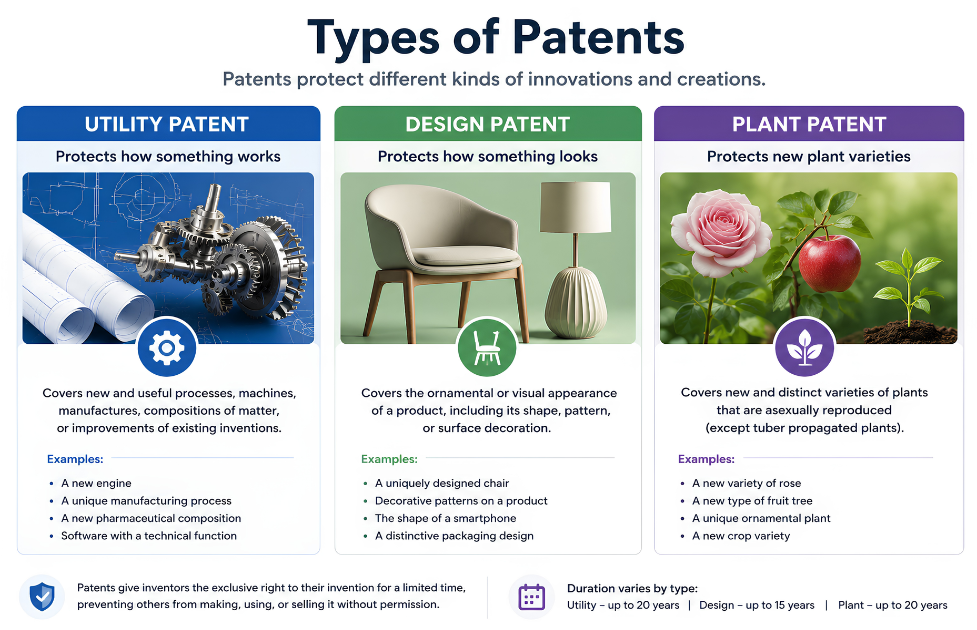
A patent is a government-issued legal right that grants an inventor exclusive control over an invention for a limited period. Patent laws encourage innovation by allowing inventors to profit from their ideas while eventually making new knowledge available to the public.
There are three primary categories:
- Utility patents
- Design patents
- Plant patents
Each serves a unique purpose and applies to different kinds of inventions.
Utility Patent

A utility patent is the most common type of patent and is designed to protect the functional aspects of an invention how it works, operates, or is used. This category covers a wide range of innovations, including medical devices, software-related inventions, manufacturing equipment, mechanical tools, electronic products, chemical formulas, and pharmaceutical innovations.
To qualify for a utility patent, an invention must generally meet three key requirements: it must be new, useful, and non-obvious, meaning it cannot be an obvious improvement to someone skilled in the relevant field. Once granted, a utility patent typically provides legal protection for up to 20 years from the filing date, provided the required maintenance fees are paid.
Design Patent
A design patent protects the ornamental appearance of a product rather than its functional features. For example, a smartphone’s unique shape, a piece of furniture, or the decorative appearance of consumer products may qualify for design patent protection.
Design patents commonly cover:
- Product packaging
- Jewelry
- Furniture
- Consumer electronics
- Household products
- Fashion accessories
Unlike utility patents, these patents protect the appearance of something rather than its functionality.
Plant Patent

Plant patents are issued for inventing or discovering and reproducing new varieties of plants through asexual reproduction.
Common examples include:
- New flower varieties
- Fruit trees
- Ornamental plants
- Hybrid roses
- Decorative shrubs
Agricultural businesses, horticultural companies, and plant breeders frequently use this type of protection.
Patent Comparison Table
| Patent Type | Protects | Common Examples | Typical Protection Period |
| Utility Patent | Functional inventions | Machines, software, medical devices, manufacturing processes | Up to 20 years |
| Design Patent | Product appearance | Furniture, smartphones, jewelry, packaging | 15 years (for most modern U.S. filings) |
| Plant Patent | New plant varieties | Roses, fruit trees, ornamental plants | Up to 20 years |
Benefits of Patent Protection
Obtaining a patent offers several important advantages beyond simply preventing copying.
Some key benefits include:
- Exclusive legal rights
- Increased business value
- Licensing opportunities
- Competitive market advantage
- Investor confidence
- Enhanced brand reputation
- Potential revenue from royalties
- Stronger intellectual property portfolio
For startups, patents can significantly improve funding opportunities by demonstrating innovation and protecting valuable technology.
How Does the Patent Filing Process Work?

The application process requires careful preparation and accurate documentation.
Step 1: Conduct a Patent Search
Before filing, search existing patents to determine whether your invention is truly original. A professional patent search helps reduce the risk of rejection.
Step 2: Prepare Your Application
A complete application generally includes:
- Detailed description
- Technical drawings
- Patent claims
- Abstract
- Inventor information
Clear documentation improves examination efficiency.
Step 3: Submit the Application
Applications are filed with the appropriate national patent office. Some inventors choose to file provisional applications first, gaining additional time before filing a complete application.
Step 4: Patent Examination
A patent examiner reviews the application to determine whether it satisfies legal requirements. The examiner may request revisions or additional clarification.
Step 5: Patent Approval
If approved, the inventor receives legal protection upon payment of any required issue fees.
Estimated Patent Costs

Patent costs in the UK can vary widely depending on the complexity of the invention and whether you use a patent attorney. Below is a realistic approximate cost breakdown in GBP :
- Patent search fees: £150 – £500
- UKIPO government filing fees: £60 – £230 (basic application fees)
- Patent attorney fees: £2,000 – £6,000+ (depending on complexity)
- Technical drawings preparation: £100 – £600
- Examination request fees: £100 – £200 (UKIPO fee)
- Renewal/maintenance fees: Start from £70 and increase yearly up to several hundred pounds as the patent ages
Simple inventions with minimal legal drafting may cost around £3,000–£5,000, while complex inventions requiring detailed technical and legal work can exceed £8,000–£15,000+.
How to Choose the Right Patent?
Selecting the appropriate protection depends entirely on your invention.
Consider these questions:
- Does the invention solve a technical problem?
- Is the innovation primarily decorative?
- Is it a newly developed plant variety?
- Are competitors likely to copy its functionality or appearance?
- Do multiple patent types apply?
In some situations, an inventor may obtain both utility and design patent protection for the same product if it contains both functional innovation and a unique appearance.
Common Mistakes to Avoid
| Common Mistake | Impact | Best Practice |
| Publicly disclosing the invention before filing. | May weaken or eliminate patent rights | File before public disclosure |
| Choosing the wrong patent type | Can delay or reduce protection | Select the appropriate patent category |
| Writing unclear patent claims | Limits legal protection | Draft clear and specific claims |
| Skipping prior art searches | Increases risk of rejection | Conduct a thorough patent search |
| Missing filing deadlines | May result in loss of rights | Track and meet all deadlines |
| Ignoring maintenance fees | Patent may expire early | Pay required fees on time |
| Filing incomplete documents | Can delay or reject the application | Submit accurate and complete documentation |
Tips for Strengthening Your Patent Application

A well-prepared application has a greater chance of approval.
Helpful strategies include:
- Keep detailed invention records.
- Document every stage of development.
- Prepare high-quality technical drawings.
- Clearly explain the invention’s advantages.
- Conduct a comprehensive prior art search.
- Respond promptly to examiner requests.
- Consider professional legal guidance for complex inventions.
Careful preparation often saves both time and money during examination.
Why Patents Matter for Businesses?
In today’s competitive market, patents are valuable business assets that protect research investments, prevent unauthorized copying, and enhance a company’s overall value. They also create opportunities for licensing revenue, support international expansion, and attract investors and strategic partners. As a result, many successful technology companies build strong patent portfolios to secure their innovations and maintain a long-term competitive advantage.
Conclusion
Understanding the types of patents is essential for effectively protecting innovations. Whether an invention requires utility, design, or plant protection depends on its purpose, appearance, and unique characteristics.
By learning the differences among patent categories, understanding the filing process, estimating costs, and avoiding common mistakes, inventors can make informed decisions that safeguard their intellectual property. Investing time in selecting the right patent strategy today can provide valuable legal protection, strengthen business growth, and maximize the long-term value of innovative ideas.
Want to know about Trainee Solicitor Salary Breakdown: Pay Ranges, Firm Types, Career Growth, and Earning Potential Across Legal Practice Levels Check out our Business Law category.
FAQs
There are three primary types of patents: utility, design, and plant. Utility patents protect the functional aspects of an invention, design patents protect its unique visual appearance, and plant patents cover new varieties of plants that are reproduced asexually.
Utility patents are the most frequently filed because they protect new and useful inventions, including machines, manufacturing processes, electronic devices, software-related innovations, and chemical compositions.
The appropriate patent depends on the nature of your invention. If it introduces a new function or process, a utility patent is generally suitable. If the innovation lies in the product’s appearance, a design patent may be the best option. New plant varieties may qualify for plant patent protection.
The duration of patent protection varies by type. Utility and plant patents generally protect for up to 20 years from the filing date, while design patents typically remain in effect for 15 years from the date of grant, subject to applicable laws and requirements.